
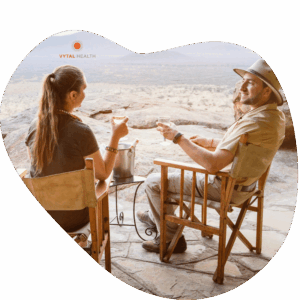
Why Community Matters for Longevity
By Loren H – Loren has worked at Vytal Health for three years
There’s a quiet truth hiding in plain sight: We are not meant to do life alone.
And yet, if I’m being honest, there are days when I barely speak to the people in my home, and actively avoid picking up the phone to chat to a friend. It feels like a heavy lift a lot of the time.
I have young children who are still in the stage where they are perpetually chatting, asking questions, but not really having a lot of deep conversations. After I’ve met their needs and finished work for the day, there isn’t a lot left in the tank.
And still, when I do make that extra effort… something shifts.
When I call a friend, go out for a walk, or bump into a neighbor, I can feel myself filling back up. Almost immediately. Like refueling.
So how did we get here?
How did something so essential start to feel like effort?
What the Longest-Living People Already Know
Researchers studying the world’s longest-living populations, places like Okinawa, Sardinia, and Ikaria, noticed something fascinating.
It wasn’t just diet.
It wasn’t just movement.
It wasn’t even just genetics.
It was a community.
In these “Blue Zones,” people consistently live into their 90s and 100s, not just longer, but healthier and more active.
And they don’t treat connection as something extra.
It’s built into their lives:
- Multi-generational families
- Daily social rituals
- Tight-knit circles that check in, show up, and share life together
They don’t have to try to connect.
They’re surrounded by it.
What Community Looks Like For Me, Right Now.
And then there’s my version of community. Right now, that looks like:
My ‘work from home’ community, people I’m in contact with most days, but only ever virtually.
Outside of work, it’s my family. I’m from the UK, so beyond the 3 humans I live with, most of my closest family and friends live in England. The connection with them often looks digital, too.
As a family, we also travel the U.S., moving from state to state each fall through spring. Which means our community is always shifting. Sometimes we have people nearby, and sometimes we don’t, for months at a time.
And yet, I know I feel better when I’m intentional.
Lately, I’ve started treating long-distance friendships as if they were local. We schedule coffee dates. Plan dinners. Sit down at the same time, hundreds or thousands of miles apart. They’ve become something to look forward to. Often the highlight of the week, with belly laughs and tears included.
When Connection Is Built In, Everything Changes
When we are physically near people we know, life looks different.
Daily walks.
Meeting at the pool with our kids.
Casual, unplanned interaction.
And I think part of the draw of traveling, and being part of the RV community, is exactly that.
There’s an unspoken connection. A shared lifestyle that translates into:
“I get you.”
We don’t have to explain ourselves. We just belong. I’ve felt that same thing before, too.
Prior to getting on the road, my family and I lived and worked at a summer camp in northern Wisconsin. Camps are these unique, closed communities, often without technology, where people live closely together for weeks or months at a time. You rely on each other, and you build something real – those relationships last. Even years later, there’s an instant bond with anyone who’s had that experience. When I witness the women at alumni camp, coming together as if no time had passed at all, it’s one of the most raw human experiences I’ve ever been privileged enough to be part of. With no words needed, they connect at a visceral level.
Everyone there just… gets each other.
So Why Does It Feel So Hard Now?
If connection is this powerful, if it literally fills us up, why does it feel so difficult?
Part of the answer is uncomfortable. We’ve made it easy not to connect. Loneliness has been shown to increase the risk of early death in a way comparable to smoking or obesity. This is not just emotional, but physical. And yet, we’re living in the most “connected” era in history. Especially with AI, remote work, and digital everything, it’s entirely possible to go a full day without meaningful human interaction.
And if I’m honest, I sometimes choose that. Like when I ask a chatbot for advice about how to get my kids to clean their room, instead of calling my mom friends. It’s faster. Easier. Less intrusive. But it’s also… emptier.
We Already Know What We Need
“We are biologically, cognitively, physically, and spiritually wired to love, to be loved, and to belong.” — Brené Brown
This isn’t just a nice idea, it’s a requirement.
Which makes this worth asking:
- Do I treat connection as essential, or optional?
- Where am I choosing convenience over closeness?
- What would it look like to prioritize belonging as much as productivity?
Because in those Blue Zone communities, connection isn’t something they squeeze in.
It is their life.
It’s Not Just Who You’re Around, It’s How They Make You Feel
Not all connections are equal.
When you leave time with your closest circle, do you feel:
- Energized or drained?
- Seen or overlooked?
- Inspired or stuck?
Because the people around you don’t just shape your mood, they shape your life, and sometimes, as we grow, our relationships don’t grow with us.
So, more important questions worth asking:
- Who makes me feel most like myself?
- Who do I need more of?
- Who might I need less of?
What Now?
This isn’t about overhauling your life overnight. Like with anything holistically health-related, it’s about small, intentional shifts.
Text someone you’ve been thinking about.
Schedule a standing weekly call.
Replace one scroll with a conversation.
Say yes to something social you’d normally avoid.
Because longevity isn’t just built in the gym or the kitchen. It’s built around dinner tables, on long walks, in shared laughter, and most importantly, in feeling like you belong.
Final Thought
If you zoom out, the question isn’t just: How long do I want to live? It’s: Who do I want to live alongside?
In the end— “We’re all just walking each other home.” — Ram Dass
And the quality of that walk, who’s beside you, how often you reach for them, how deeply you show up, might matter more than anything else.